

Marketing departments deal with numerous channels, platforms, and touchpoints with customers daily. Paper-based implementation reduces growth and causes more errors. That’s where tools for marketing automation make a measurable difference.
Automation marketing systems assist companies in simplifying campaigns, lead management, customer journey personalization, and performance tracking without increasing operational costs.
From startups to businesses, the appropriate platform transforms the disjointed efforts into a networked system. By 2025, 76% of companies worldwide use tools for marketing automation, showing widespread adoption across industries.
This article breaks down the 10 top tools for marketing automation, explaining what each tool does best and how it supports real business goals.
What Are Tools for Marketing Automation?
Before comparing platforms, it helps to understand what marketing automation tools are and why they matter. Over 76% of companies globally use marketing automation tools in 2025, showing widespread adoption across industries.
Marketing automation tools refer to software platforms that automate, manage, and optimize marketing activities in various channels, such as:
- Email and messaging
- Lead generation and nurturing.
- CRM and sales alignment
- Social media scheduling
- Customer journey tracking
- Analytics and attribution
Rather than handling these activities individually, automation solutions consolidate data and processes, enabling marketers to concentrate on strategy and not on repetitive implementation.
The Importance of Selecting the Right Tool
Not every business requires the same features. A company that opens its initial campaigns is not the same as an enterprise that conducts account-based marketing. Firms using automation generate 451% more qualified leads, proving how automated nurturing significantly boosts lead quality.
The best tools for marketing automation help businesses:
- Enhance productivity without losing customization.
- Channel scale campaigns.
- Integrate marketing and sales.
- Make data-driven decisions
Selecting an inappropriate tool may cause underutilization of features, unnecessary expenses, or a lack of scalability.
Top Tools for Marketing Automation and How They Help
The 10 most popular marketing automation tools are listed below, and each has its purpose based on the size of the business, the industry, and the objectives.
1. HubSpot
Best in: All-in-one marketing, sales, and CRM automation.
HubSpot is a marketing automation, CRM, sales, content management, and analytics platform. 89% of businesses say marketing automation helps them create more personalized and effective customer journeys.
It assists companies in automating:
- Lead capture and nurturing
- Customer journey tracking
- Channel campaign reporting.
- Handoffs in marketing and sales.
HubSpot is effective when a company needs to have one system instead of using numerous tools.
2. ActiveCampaign
Best in: Advanced automation and behavioral targeting.
ActiveCampaign is dedicated to the automation of behavior and customer experience personalization. 88% of marketers say personalized content driven by automation boosts engagement with target audiences.
It helps businesses:
- Automate user behavior.
- Construct channel-to-channel conditional workflows.
- Dynamically segment audiences.
- Maximize conversion rates by personalizing.
This is the tool that is favored by the teams that desire flexibility but not the complexity of the enterprise level.
3. Adobe Marketo Engage
Best use: Enterprise B2B marketing automation.
Marketo is designed with large organizations with lengthy sales cycles and complicated customer journeys.
It helps enterprises:
- Conduct account-based marketing programs.
- Automate lead scoring and nurturing.
- Track revenue attribution
- Organize massive campaigns.
The strength of Marketo is scalability and deep analytics, instead of simplicity. Automated campaigns deliver 320% more revenue than non-automated campaigns, highlighting the impact on overall marketing ROI.
4. Mailchimp
Best: Small businesses moving to automation.
Mailchimp is a more affordable and easier to learn automation platform with a low learning curve.
It helps small teams:
- Automate simple customer experiences.
- Control audiences and segmentation.
- Launch campaigns quickly
- Monitor performance without configuration.
Although not as sophisticated as enterprise tools, Mailchimp is a good choice at the initial stage of automation.
5. Brevo (Formerly Sendinblue)
Best in: Multi-channel automation at a low cost.
Brevo embraces automation in email, SMS, WhatsApp, chat, and CRM.
It helps businesses:
- Convey through various channels.
- Automate marketing and transactional messages.
- Contact and pipeline management.
- Scale campaigns at a low cost.
This renders Brevo a good option for companies that want to be affordable and have channel diversity.
6. Klaviyo
Best application: marketing automation of e-commerce.
Klaviyo is created to be used by a brand that dependgreatly s on customer behavior and purchase data.
It assists eCommerce companies:
- Automate campaigns for browsing and purchase.
- Individualize product suggestions.
- Increase repeat purchases
- Enhance customer lifetime value.
Klaviyo is closely connected with online stores, which means that automation is very data-oriented.
7. Pardot (Salesforce Marketing Cloud Account Engagement)
Best use: B2B teams that are Salesforce-based.
Pardot is developed to be used by companies that are already using Salesforce CRM.
It helps B2B organizations:
- Automate lead qualification and nurturing.
- Match marketing with sales pipelines.
- Monitor activity on accounts.
- Enhance teamwork.
Close Salesforce integration is its greatest strength.
8. Zoho Marketing Automation
Best in: Small Business Expansion with Zoho products.
Zoho Marketing Automation is a natural part of the Zoho ecosystem. 80% of marketers using marketing automation report improved lead generation when compared to manual techniques.
It helps businesses:
- Automate lead generation and segmentation.
- Planned multichannel journeys.
- Evaluate campaign performance.
- Market at a low cost.
Zoho is an excellent choice for teams that require flexibility and do not need enterprise pricing.
9. Drip
Best in: Direct-to-consumer and creator-led brands.
Drip is event-driven for automation, as opposed to fixed campaigns.
It helps brands:
- React to customer activities instantly.
- Create customized experiences.
- Monitor touchpoint interaction.
- Increase retention by relevance.
Drip suits businesses well with customers who are dependent on customer behavior as opposed to general messaging.
10. GetResponse
Most appropriate: Funnel marketing and lead generation.
GetResponse is a combination of automation, landing pages, webinars, and conversion funnels. 45% of marketing automation users report increased conversion rates compared to non-automated efforts.
It helps marketers:
- Automate lead acquisition processes.
- Develop opportunities in systematic funnels.
- Control campaigns between acquisition and conversion.
- Monitor the performance of stages.
The tool is appropriate for teams that are concerned with quantifiable growth and systematic campaigns.
Marketing Automation Tools for Startups vs Enterprises
Not every tool is applicable in every phase of development.
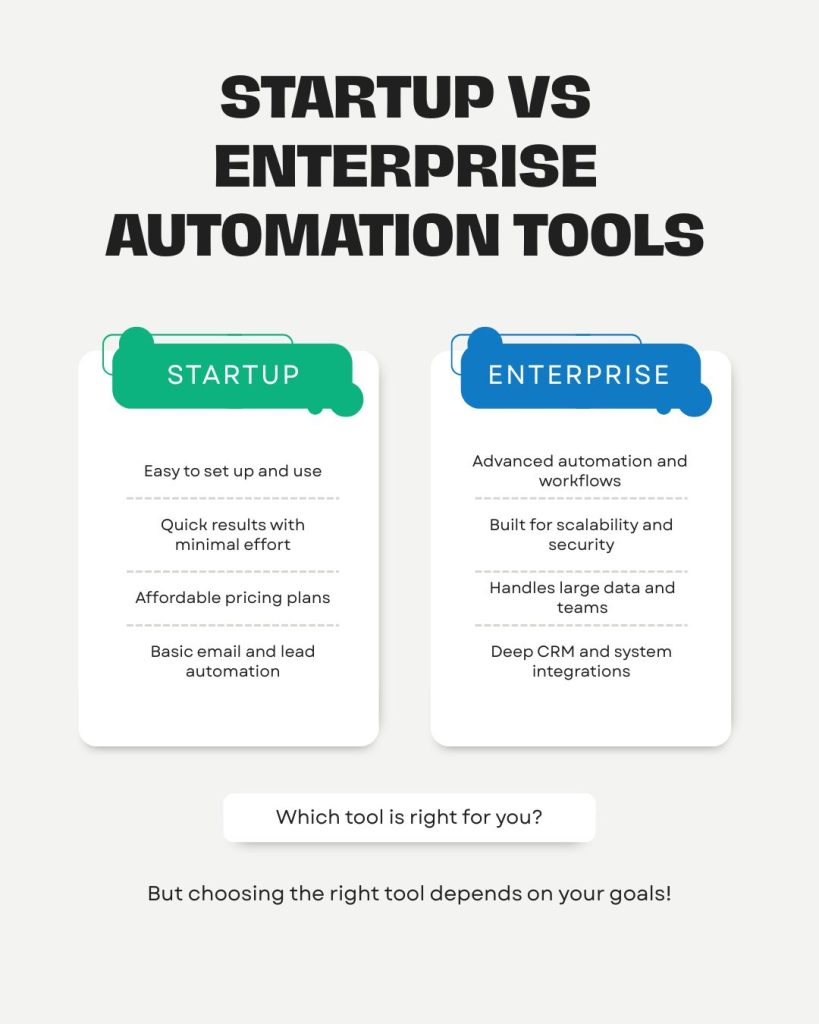
Marketing automation tools for startups typically focus on:
- Ease of use
- Lower costs
- Core automation features
Enterprise platforms give importance to:
- Scalability
- Advanced segmentation
- Integration and data governance.
Aligning the tool with your business stage will avoid spending money on idle functionality.
Free and Paid Marketing Automation Tools
Many platforms offer marketing automation tools for free plans or trials.
Free tools are useful for:
- The concepts of automation of testing.
- Minimal lists and minimal workflows.
- Early-stage businesses
Paid tools unlock:
- Advanced automation logic
- Deeper analytics
- Higher contact limits
- Better integrations
The upgrade will be reasonable when automation has a direct effect on revenue.
How to Choose the Best Tool for Marketing Automation?
When reviewing a marketing automation tools list, focus on:
- Business size and growth strategies.
- Channels you actively use
- Integration requirements
- Budget and scalability
- Team expertise
The best tools for marketing automation are the ones your team will actually use consistently.
Conclusion
Marketing automation tools do not substitute strategy; they just make it more effective. The correct platform enables companies to perform more quickly, customize more, and expand without resistance.
Whether you’re evaluating top marketing automation tools for the first time or replacing an existing platform, clarity on goals and use cases makes all the difference.
FAQs
1. What are marketing automation tools?
Marketing automation applications are automated email, lead nurturing, segmentation, and tracking tools that enable businesses to scale personalized marketing effectively without manual work.
2. Do startups need marketing automation tools?
Yes, marketing automation tools for startups simplify workflows, save time, reduce costs, and support growth with scalable features and affordable plans.
3. What are the best tools for marketing automation?
The best tools for marketing automation include HubSpot, ActiveCampaign, Mailchimp, Brevo, and Klaviyo, depending on business size and goals.
4. Do we have any free marketing automation tools?
Marketing automation tools for free plans exist, offering basic email automation, contact management, and analytics, ideal for early-stage or small teams.
5. What is the time taken to establish automated email workflows?
Many automated email processes can be configured in hours, based on complexity, familiarity with the tools, content preparation, and testing needs.