

Contemporary software does not often operate on its own. The applications communicate with databases, APIs, third-party tools, and legacy systems daily. Failure of these moving parts to coordinate leads to disrupted workflows, user dissatisfaction, and expensive repairs. This is where system integration and testing become essential.
This article breaks down what system integration is, how testing fits into the picture, and why system integration testing plays a critical role in delivering reliable software. Research shows organizations implementing Continuous Integration see up to 40% higher defect detection rates and 200% faster deployment frequency.
What Is System Integration?
System integration is the process of combining different software components or subsystems into a single, functioning system. These modules can be created by other teams, be based on different technologies, or even be third-party vendors.
The goal of system integration is simple: make sure all parts communicate correctly and behave as expected once connected.
Examples of system integration include:
- Linkingthe frontend application and backend services.
- Combining payment gateways and eCommerce sites.
- Integrating CRM systems and marketing automation systems.
Even well-constructed individual modules may not work when they are integrated, unless done properly.
What Is Testing in Software Development?
Testing refers to the process of testing software in order to detect defects, gaps, or unforeseen behavior. It makes sure that the system is both technical and business-wise. An engineering study found that defect detection per cycle increased 43%, and 68% of critical defects were found before integration testing.
Answering such questions as:
- Is the feature functioning properly?
- Is the system able to deal with errors?
- Are the important tasks done by the users without friction?
The various types of testing target the various levels of the system, ranging from individual functions to entire applications.
System Testing and Integration Testing: Where Do They Fit?
System testing and integration testing often get confused, even among experienced teams. They are used ifordifferent purposes and occur at various stages.
Integration testing is concerned with the cooperation of components.
System testing deals with the overall functionality of the system.
They are both necessary, but they address different issues. The knowledge of the difference aids teams in identifying problems at an earlier stage and minimizing rework at a later stage.
What Is System Integration Testing?
System integration testing (SIT) validates the interaction between integrated components within a complete system environment. It makes sure that data flows in the right direction, interfaces work as intended, and dependencies work as intended. Quality research reportsa 30–40% reduction in post-release issues and a 3:1 ROI from comprehensive integration testing practices.
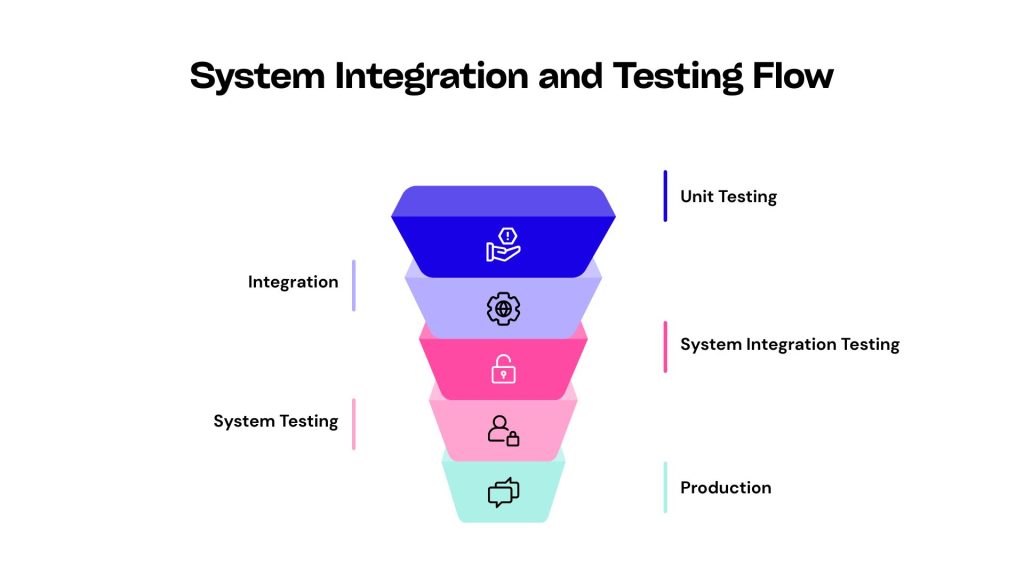
Simply put, SIT will answer the following question:
Does the system have all the integrated parts that are not broken?
System integration testing happens after unit testing and before full system testing.
System Integration Testing: Meaning in Real Projects
The meaning of system integration testing becomes clearer when seen in practice. Industry data shows teams using continuous integration and automated testing cut post-release issues by up to 40%.
Imagine an online store:
- The cart module works out prices.
- Transactions are done in the payment module.
- The inventory system updates the inventory.
Each of the modules can be ideal in its own right. SIT verifies that:
- Prices transmitted to the payment gateway are correct.
- Inventory updates are initiated by payments.
- Mistakes revert to significant messages.
This phase identifies failures that cannot be identified by isolated testing.
What are the Different Types of System Integration?
Various systems need various integration strategies. Common system integration types include:
Point-to-Point Integration
Direct system interrelationships. Simple to install and challenging to expand.
Enterprise Service Bus (ESB)
Middleware-based centralized integration. Applicable in big business settings.
API-Based Integration
Modern and flexible. Usually found in microservices and cloud-native applications.
Event-Driven Integration
Events are used to communicate between systems. Enhances scalability and responsiveness.
Each integration type influences how system integration and testing should be planned.
System Integration Testing Techniques
Choosing the right system integration testing techniques depends on system complexity, timelines, and risk tolerance. A biomedical open source analysis found integration testing is used in 64% of projects, system testing in 75%, and continuous testing in 60%.
Big Bang Integration Testing
All the components are assembled simultaneously and tested collectively.
Pros
- Simple setup
- Fewer test cycles
Cons
- Difficult debugging
- High risk if failures occur
Top-Down Testing of Integration
Testing begins at the high-level modules and works down.
Best for
- High-level workflow validation.
Challenge
- Needs lower module stubs.
Bottom-Up Integration Testing
The process of testing starts with the low-level modules and proceeds upwards.
Best for
- Certifying core services and utilities.
Challenge
- Late user flow validation.
Hybrid (Sandwich) Integration Testing
Integrates both the top-down and bottom-up strategies.
It is a risk and coverage balancing method that is common in complex systems.
Difference Between System Testing and System Integration Testing
This difference is essential in terms of test planning and clarity to the stakeholders.
| Aspect | System Integration Testing | System Testing |
| Focus | Component interactions | Entire system behavior |
| Scope | Interfaces, data flow | Functional and non-functional |
| Environment | Integrated modules | Production-like setup |
| Goal | Catch integration issues | Validate business requirements |
System integration testing checks connections. Finalization of system testing.
Why System Integration and Testing Matter?
Skipping or rushing system integration and testing leads to predictable problems:
- Lost production integrations.
- Data inconsistencies
- Increased support tickets
Well-executed SIT provides:
- Early defect detection
- Reduced deployment risk
- Increased trust in releases.
Invested teams also spend less time on firefighting in the future.
Common Challenges in System Integration Testing
Even teams that are mature have challenges in SIT.
Unstable Test Environments
Shared systems are known to change randomly, which disrupts tests.
Lack of full Interface Documentation
Lack of specs is a cause of assumptions and flaws.
Data Dependencies
Wrong or inaccurate test data covers up actual problems.
Third-Party System Limitations
External APIs can act unpredictably or impose a rate limit.
These roadblocks are reduced by planning.
Best Practices for System Integration and Testing
Good performance is achieved through rigorous training.
- Early integration testing.
- Have clean API contracts.
- Automate repetitive integration tests.
- Use realistic test data.
- Integration points of logs and monitors.
Frequent cooperation of developers, testers, and DevOps teams enhances results as well.
Conclusion
System integration and testingplays a critical role in delivering stable, scalable, and dependable software systems. With the increase in the interconnectedness of applications, the probability of failure at the points of integration is also high.
System integration testing helps teams validate data flow, interfaces, and dependencies before the software reaches users. Defect reduction, cost control, and more confident and consistent release of software can be achieved by organizations through the right integration techniques, clear communication between teams, and early-lifecycle testing.
FAQs
1. What is system integration testing?
System integration testing verifies that integrated software components interact correctly, ensuring data flow, interfaces, and dependencies function as expected.
2. What is the difference between system testing and system integration testing?
System integration testing checks component interactions, while system testing validates the complete system against functional and business requirements.
3. Why is system integration and testing important?
System integration and testing detect interface issues early, reduce production defects, and ensure stable performance across connected software components.
4. What are common system integration testing techniques?
The most frequently used methods are the big bang, top-down, bottom-up, and hybrid integration testing methods.
5. When should system integration testing be performed?
System integration testing should occur after unit testing and before full system testing in the software development lifecycle.