

Marketing teams are more channel-driven, full of data, and more demanding than ever. Emails, leads, follow-ups, CRM updates, and reporting soon accumulate. Everything is slowed down by manual execution.
That’s where marketing automation steps in. It assists companies to automate repetitive processes, provide individualized experiences, and convert leads in a more efficient way without exhausting their staff. Companies using marketing automation see up to 451 % increase in qualified leads compared to manual processes and stronger conversions, highlighting automation’s impact.
Whether you run a startup or manage enterprise campaigns, understanding marketing automation can reshape how you attract, engage, and retain customers.
What Is Marketing Automation? (Definition & Meaning)
Marketing automation refers to the use of software and technology to automate, manage, and measure marketing tasks and workflows across multiple channels.
In simple terms, marketing automation means using tools that handle repetitive marketing actions automatically, while still keeping communication relevant and personalized.
Marketing Automation Definition
Marketing automation is the process of using digital platforms to:
- Capture leads
- Segment audiences
- Send targeted messages
- Track user behavior
- Engagement-based trigger actions.
Automation is performed in the background and responds to the user’s action in real time instead of sending a one-off campaign manually.
What Is Marketing Automation Used For?
Businesses use digital marketing automation to improve efficiency and consistency across campaigns. Marketing automation saves time for 74 % of marketers, enabling them to redirect effort from routine tasks to strategic work.
Common use cases include:
- Automated email sequences
- Lead nurturing and scoring
- CRM data syncing
- Customer onboarding flows
- Retargeting campaigns
- Performance tracking
Automation enables the marketer to concentrate on strategy and creativity, and systems to execute.
Why Marketing Automation Is Important for Business Growth?
Contemporary consumers are demanding quick service and customized communication. Paper-based procedures cannot keep pace.
Here’s why marketing automation is important for sustainable growth:
- Speed: Automated processes react immediately to customer activities.
- Consistency: All leads are communicated in time.
- Scalability: The campaigns can be executed easily and efficiently as databases increase.
- Data clarity: The process of performance tracking becomes more accurate and easier.
Teams that adopt marketing automation often see better alignment between marketing and sales, along with higher conversion rates. About 76 % of companies worldwide use marketing automation tools today to reduce manual workload and improve campaign efficiency.
Core Benefits of Marketing Automation
Improved Lead Nurturing
Automation makes sure that leads are delivered with the appropriate content at the appropriate moment, not by chance. About 62 % of B2B companies use automation specifically for nurturing leads throughout the buyer journey.
Higher Conversion Rates
Individual messages and prompt follow-ups enhance interest and purchase.
Time and Cost Efficiency
Monotonous work functions automatically, and the teams are able to work on strategy and optimization.
Better Customer Experience
Relevant and well-timed interactions are not intrusive but helpful.
Clearer Marketing ROI
Performance can be measured using automation platforms that track all clicks, open, and conversions. 91 % of marketers state marketing automation is critically important to overall campaign success and revenue growth.
These marketing automation benefits compound over time, especially as campaigns scale.
Marketing Automation Workflows Explained
A marketing automation workflow is a predefined sequence of actions triggered by user behavior or conditions.
Workflow is like a case of this, then that is applied to marketing.
Example Workflow
- User downloads an ebook
- System sends a welcome email
- After 2 days, sends a follow-up
- In case the email is clicked, give a better lead score.
- Send a notification to sales in case of the score threshold.
Common Marketing Automation Workflows
- Welcome and onboarding processes.
- Chairperson drip campaigns.
- Abandoned cart follow-ups
- Re-engagement campaigns
- Post-purchase upsells flows
The proper development of workflows ensures that communication is not overloaded with irrelevant information.
Marketing Automation Services: What Businesses Can Outsource?
All companies do not develop automation systems internally. Many rely on marketing automation services to speed up implementation.
These services normally involve:
- Design of workflow and strategy.
- Setting up and integrating platforms.
- CRM configuration
- Automation of email and landing page.
- Optimization and reporting performance.
In the case of expanding businesses, automation outsourcing prevents expensive establishment errors and reduces the time to deliverables.
CRM for Marketing Automation: Why Integration Matters ?
A CRM for marketing automation connects customer data with marketing actions.
In the case of CRM and automation platforms collaboration:
- Sales experiences live lead activity.
- Marketing monitors pipeline effect.
- Customer information remains stable.
- Follow-ups are more personal.
Automation is contextually lost without CRM integration. Campaigns are in tandem with revenue targets.
Digital Marketing Automation Across Channels
Modern digital marketing automation goes beyond email.
It supports:
- Social media scheduling
- Paid ad retargeting
- Website personalization
- SMS and push notifications
- Cross-channel attribution tracking.
This multichannel strategy enables the development of a single customer experience, even when the user changes platforms.
Common Marketing Automation Mistakes to Avoid
Automation can only be effective when implemented carefully.
Avoid these pitfalls:
- Automation without customization.
- Sending too many messages
- Ignoring data hygiene
- Constructing processes without objectives.
- Failing to test and optimize.
Robotization ought to improve relations- not to substitute human judgment.
How to Get Started with Marketing Automation?
Adoption is easier when it is structured.
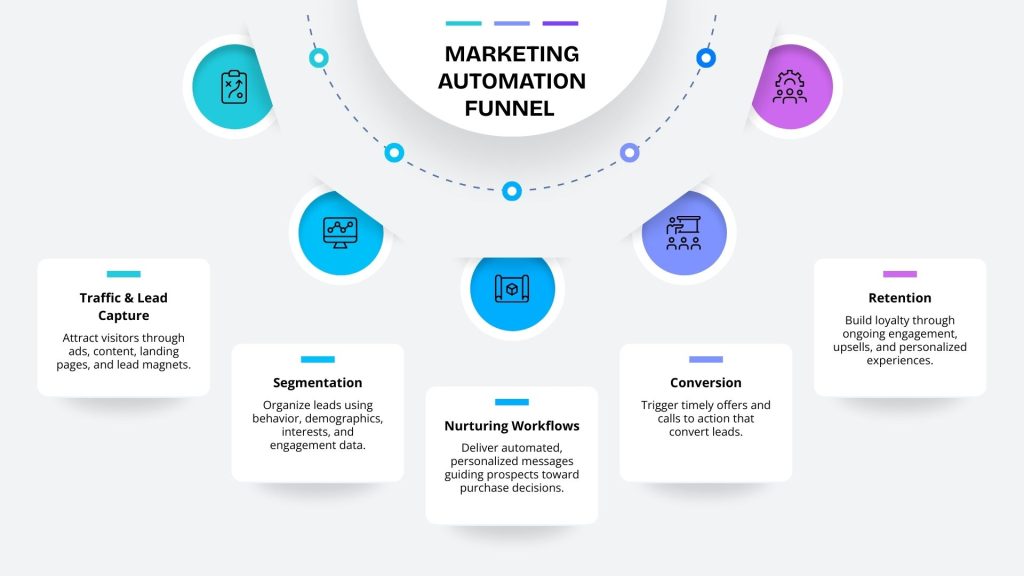
Step-by-Step Approach
- Define goals and KPIs
- Map the customer journey
- Choose the right platform
- Construct basic workflows initially.
- Measure, refine, and scale
Beginning small enables teams to have confidence in automation before increasing their automation.
The Future of Marketing Automation
Marketing automation continues to evolve.
Key trends include:
- AI-driven personalization
- Predictive lead scoring
- Privacy-first data handling
- Greater integration of CRM and analytics.
With the increased use of technology, automation will not be as mechanical as it will be more human when properly applied.
Conclusion
For businesses looking to scale without sacrificing personalization, marketing automation is no longer optional.
It enhances efficiency, customer relationships, and gives clear performance insights. Combined with the appropriate strategy, it is a long-term growth engine.
FAQs
1. What is marketing automation?
Marketing automation uses software to automate marketing tasks, manage campaigns, nurture leads, and deliver personalized customer experiences efficiently.
2. Why is marketing automation important?
Marketing automation improves efficiency, increases conversions, personalizes communication, aligns sales and marketing, and delivers measurable ROI at scale.
3. What are the benefits of marketing automation?
The most important advantages are time savings, improved nurturing leads, increased engagement, better customer experience, scalability, and marketing decisions based on data.
4. What tools are used for marketing automation?
Marketing automation tools include email platforms, CRMs, workflow builders, analytics dashboards, and AI-powered systems for campaign optimization.
5. How does CRM support marketing automation?
A CRM for marketing automation centralizes customer data, tracks behavior, enables personalization, improves follow-ups, and aligns marketing with sales teams.